Seismic-resistant building material: AAC plays the star role
An earthquake is a force of nature. It is an unavoidable reality in Bangladesh nowadays. So,
seismic-resistant construction is not a nice-to-have feature; it is necessary. Traditional construction
materials are strong but often fail to provide the flexibility and weight reduction necessary during seismic
activity. This is where autoclaved aerated concrete (AAC) comes in as an excellent solution.
AAC is a smart building material. In seismic-prone zones,
it is not an alternative now; it is the first choice. In this blog, you will learn why AAC is the ideal
choice for seismic building materials.
What are seismic-resistant materials, and why do they matter?
During an earthquake, horizontal and vertical ground movement create inertia forces that act on the building
mass. The heavier the structure, the greater the force it must endure. Conventional materials like
concrete blocks and
clay bricks significantly increase the dead load of structures. This added force is
dangerous for the building because it increases the risk of cracks, collapse, and structural damage. That's
why engineers today focus on reducing mass while maintaining strength. This is where seismic-resistant
building materials come in.
Seismic-resistant building materials are construction materials that help buildings to endure earthquakes
by reducing damage and preventing sudden failure. Their ability to control movement, stress, and structural load makes them significant. Below are given
some key important seismic-resistant materials:
Autoclaved Aerated Concrete (AAC)
Steel structure
Properly designed reinforced concrete
Engineered wood
Fiber-reinforced polymer (FRP)
How does AAC play the star role?
Autoclaved Aerated Concrete (AAC) is a precast, lightweight form of cellular concrete made from cement,
lime, sand, water, and a small amount of aluminum powder. During production, a controlled expansion process
creates millions of uniformly distributed air pockets. This is what gives AAC its unique advantage:
significantly lower weight without sacrificing structural strength.
Here are a few main arguments for why AAC is the best:
Lightweight by design: AAC blocks are up to three times lighter than traditional clay bricks. Lower
wall weight directly reduces seismic force acting on the structure. Less force means less damage.
High strength-to-weight ratio: Despite being lightweight, AAC provides reliable load-bearing
capacity. It supports structural stability while allowing buildings to respond more safely to ground
movement.
Improved seismic behavior: Reduced dead load improves overall earthquake resistance. AAC walls are
better at absorbing and dissipating seismic energy instead of cracking or failing suddenly.
Fire-resistant by nature: AAC is non-combustible and can resist fire for several hours. This is
critical, as post-earthquake fires are a common and serious risk.
Excellent thermal insulation: The air-pocket structure offers natural insulation, keeping buildings
cooler in summer and warmer in winter—often without the need for additional insulation layers.
Faster construction time: Larger block sizes, lighter weight, and easy handling speed up masonry
work and reduce labor dependency.
Lower structural and foundation costs: Reduced wall weight allows for smaller foundations and lower
steel consumption, directly cutting overall construction costs.
Eco-friendly and sustainable: AAC uses fewer raw materials, produces minimal waste, and lowers
carbon emissions compared to conventional masonry materials.
Long-term performance: Factory-produced AAC blocks offer uniform dimensions, predictable strength,
and long-lasting durability—key factors for safe and reliable buildings.
Why lightweight materials matter in earthquake-prone regions
Bangladesh sits close to several active fault lines, and most structural damage during earthquakes happens
because of excessive dead load. Heavier buildings generate higher inertia forces when the ground moves,
which puts extreme stress on columns, beams, and joints.
AAC blocks directly address this problem. By significantly reducing wall weight, AAC lowers the overall
seismic demand on the structure. This allows engineers to design safer buildings with better load
distribution, reduced cracking, and improved post-earthquake stability. For mid-rise residential and
commercial buildings, this weight reduction can be a decisive safety factor.
AAC blocks vs traditional bricks in seismic performance
Traditional clay bricks and dense concrete blocks increase dead load and behave rigidly during seismic
movement. When stress exceeds their capacity, failure is often sudden and brittle.
This combination makes AAC a smarter walling material for modern seismic-resistant construction, especially
where soil conditions and construction quality can vary.
Choose Zihan Tech for high-quality AAC block
Zihan Tech is the only official business partner of the
Dongyue Group in
Bangladesh. Dongyue is one of the
leading German standard AAC block machinery manufacturer in China. Our world-class machines
produce high-quality AAC blocks that protect lives and investments. Blocks produced from our machines
increase stability and ensure safe, long-lasting building.
As a professional AAC block machine supplier, we supply all over Bangladesh. We are
committed to providing sustainable and cost-effective solutions. Why we are the best choice:
Proven manufacturing precision: Our AAC block machines follow advanced production standards to
ensure uniform density, accurate dimensions, and dependable compressive strength.
Flexible production capability: Machines support multiple block sizes and specifications, allowing
manufacturers to serve residential, commercial, and industrial projects without compromise.
Sustainability-driven engineering: Optimized curing and material usage reduce waste, energy
consumption, and environmental impact.
Technical guidance: Our engineers support clients with plant setup, process optimization, and
production efficiency—not just machine delivery.
Reliable nationwide supply support: From installation to after-sales service, we ensure smooth
operations across Bangladesh.
Built for seismic performance: Blocks produced using our machines are engineered for lightweight
strength—ideal for earthquake-resistant structures.
Final words
Earthquakes are unpredictable, but construction choices don’t have to be. Seismic-resistant buildings start
with smart material selection, and AAC blocks have proven to be
one of the most reliable solutions for reducing structural risk without sacrificing strength or
durability.
By combining lightweight performance, thermal efficiency, fire resistance, and sustainability, AAC plays a
key role in modern earthquake-safe construction in Bangladesh. Zihan Tech supports this
shift by delivering advanced
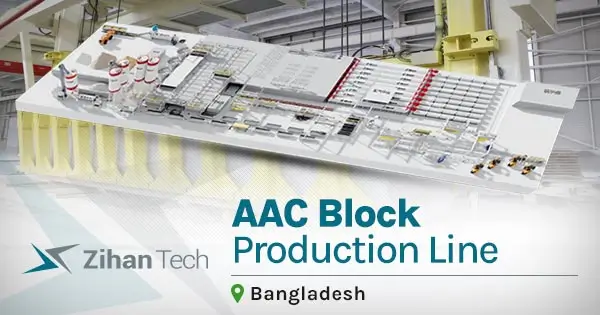
AAC block production technology
that helps manufacturers produce high-quality blocks. If your goal is safer buildings, lower structural
load, and long-term performance, AAC is the way forward.
AAC blocks are light in mass but have high strength properties, contributing towards a lower overall
gravity load for a building. A lower dead load makes a structure perform better in earthquakes.
Yes. The blocks are manufactured under strict conditions and are thus strong, durable, and resistant
to the elements.
Yes. AAC blocks have varied sizes and specifications to adapt to residential, commercial, or
industrial purposes.
Carbon emissions are lower, the quantity of raw materials required is less, and waste generation is
minimal in AAC blocks.
Yes. Because they are lighter, with a large size, they can be installed faster, with less labor, and
with a reduced structural cost.
Need earthquake-safe materials?
AAC is a smart choice for seismic zones, offering lightweight strength and flexibility to improve safety
and performance during earthquakes.
Looking for an AAC Block and Panel Production Line in Bangladesh? Get high-quality, efficient solutions with Zihan Tech. Contact us for a free quote today!



 +8801841119091