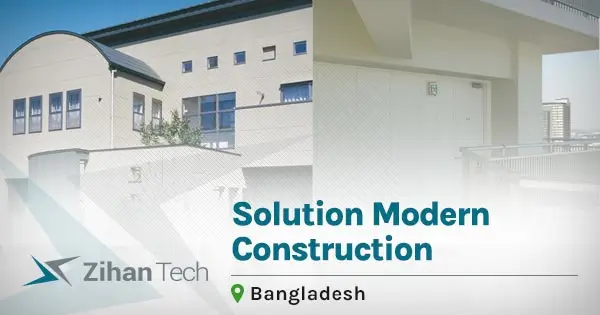
Build smart with AAC Block and save construction cost
Construction decisions made in the early stages of a
project often determine the final cost, structural
efficiency, and long-term performance of the building.
For developers and contractors looking to build smarter,
AAC blocks have become one of the most practical
alternatives to traditional clay bricks.
Across modern construction projects, AAC blocks are
increasingly used because they reduce structural load,
simplify masonry work, and lower overall construction
costs. When planned correctly, they can significantly
improve both the efficiency and durability of a
building.
In this blog, we will break down what AAC blocks are and
why they are becoming a smart choice for modern
construction.
AAC stands for Autoclaved Aerated Concrete. It is
a lightweight precast building material made from
cement, lime, sand, water, and a small amount of
aluminum powder.
During manufacturing, the mixture undergoes a chemical
reaction that forms tiny air pockets inside the
material. These air pockets are what make AAC blocks
lightweight while still maintaining strong structural
performance.
After the reaction process, the blocks are cured in
high-pressure steam chambers known as autoclaves, which
gives the material its strength and durability. The
result is a block that is:
Lighter than traditional bricks
Thermally efficient
Fire resistant
Easier to install
Structurally efficient
Because of these properties, AAC blocks are widely used
in residential buildings, commercial complexes, and
high-rise developments.
Why AAC Blocks are becoming popular in modern
construction
Many developers initially focus on material price alone
when choosing wall materials. But construction
efficiency depends on several factors beyond the
purchase cost. AAC blocks bring advantages that affect
the entire construction process.
Faster construction
AAC blocks are larger than traditional bricks. Fewer
units are required per square meter, which speeds up
masonry work and reduces construction time.
Reduced structural load
AAC blocks are significantly lighter than clay
bricks. This reduces the dead load on the building
structure, which can influence foundation and
structural design.
Thermal insulation
The air pockets inside AAC blocks act as natural
insulation, helping buildings maintain more stable
indoor temperatures.
Fire resistance
AAC blocks are non-combustible and offer high fire
resistance, making them safer for residential and
commercial buildings.
Precision and uniformity
AAC blocks are manufactured with high dimensional
accuracy, which reduces plaster thickness and
improves finishing quality.
While bricks have been used for centuries, AAC blocks are
designed to meet the demands of modern construction
where efficiency, speed, and structural optimization are
critical.
How AAC blocks help reduce construction cost
One of the biggest reasons developers consider AAC
blocks is their ability to lower the overall cost of a
project. The savings usually come from several areas
rather than a single factor.
1. Material cost
At first glance, the price per block may appear higher
than traditional bricks. However, the larger size of AAC
blocks means fewer units are needed. For example:
An AAC block can replace up to seven traditional
bricks
Less mortar is required
Less plaster is often needed due to smooth surfaces
This can balance or even reduce the total material cost
for wall construction.
2. Labor cost
Labor efficiency is one of the biggest advantages.
Because AAC blocks are larger and easier to handle:
Masonry work becomes faster
Fewer workers are required per square meter
Construction timelines shorten
In many projects, developers see noticeable savings in
labor costs and project duration.
3. Reduced structural load
AAC blocks are much lighter than clay bricks. This weight
difference directly affects structural design. Typical
comparisons show:
AAC block density: around 550–650 kg/m³
Brick density: around 1800 kg/m³
This lighter weight reduces the dead load of the
building, which can lead to:
Lower steel consumption
Reduced structural reinforcement
Potential savings in foundation design
Over an entire building, these reductions can produce
significant cost benefits.
4. Energy cost
AAC blocks possess excellent thermal insulation
properties. Additionally, they significantly reduce
sound transmission, making them suitable for
sound-resistant wall construction. So:
Reduces air conditioning costs.
Minimizes the need for additional soundproofing in
modern construction.
Cost comparison between AAC block and Traditional block
While prices vary by supplier and project scale, the
following simplified comparison illustrates typical cost
considerations.
Cost factor
AAC block
Traditional brick
Material Requirement
Lower block quantity
Higher brick quantity
Mortar Usage
Lower
Higher
Labor Time
Faster
Slower
Structural Load
Lower
Higher
Overall Efficiency
High
Moderate
Because construction involves multiple cost layers, AAC
blocks often deliver better total project economics,
even if the initial material price seems slightly
higher.
Practical benefits for developers and contractors
AAC blocks provide several operational advantages. For
large housing developments or commercial projects, these
advantages help improve both productivity and
profitability. Here are some common advantages of AAC
block:
Improved construction speed: Faster wall
construction allows projects to progress quickly to
finishing stages.
Easier handling: The lighter weight reduces
worker fatigue and simplifies transportation within
the site.
Sustainability benefits: The production of
AAC blocks is much more Carbon safe than traditional
bricks, and no agricultural soil is mined during the
process. This contributes to environmentally
responsible construction.
Why choose Zihan Tech for AAC block solutions
Reliable materials and production systems are essential
for maintaining consistent quality in construction
projects. Zihan Tech provides AAC
block solutions
along with modern manufacturing technology, such as the
AAC
block production line, supporting builders and
industrial investors. Key advantages include:
Advanced AAC block production technology
Reliable supply of AAC-related materials
Technical support for block manufacturing
systems
Efficient solutions for modern construction
projects
Common misconception about AAC blocks
Many homeowners and small builders don’t even know what
AAC blocks are. Despite growing adoption, some
misconceptions still exist around AAC blocks.
Myth 1: AAC blocks are weak In reality, AAC
blocks are designed to provide sufficient
compressive strength for modern construction when
used correctly.
Myth 2: AAC blocks are expensive When
considering total construction cost, AAC blocks
often become more economical due to labor and
structural savings.
Myth 3: They are difficult to install AAC
blocks are actually easier to cut, shape, and
install compared to traditional bricks.
Myth 4: They cannot be used in high-rise
buildings AAC blocks are widely used in
multi-story structures around the world because
their lightweight nature benefits structural
design.
Start
building
smarter with AAC blocks
AAC blocks provide a modern solution for
faster, lighter, and more efficient
construction.
Planning a project or exploring AAC
production systems?
Contact us to learn more about materials and
supply options.
AAC blocks are mainly used for wall
construction in residential, commercial,
and industrial buildings. They are
suitable for both interior and exterior
walls.
AAC block prices vary depending on block
size, supplier, and order quantity.
However, when calculated per square
meter of wall construction, the cost is
often competitive with traditional brick
masonry.
AAC blocks have sufficient compressive
strength for most building applications.
While they are lighter than bricks, they
are engineered to meet structural
construction requirements.
Yes. Because AAC blocks are larger and
easier to install, masonry work can be
completed faster compared to traditional
brick construction.
Yes. Their lightweight nature reduces
structural load, making them suitable
for multi-story construction projects.
AAC blocks are usually installed using
thin-bed adhesive mortar rather than
traditional cement mortar, which
improves bonding and reduces material
usage.
AAC blocks are considered more
sustainable than clay bricks because
they require fewer raw materials and
generate less construction waste.
Yes. The thermal insulation properties
of AAC blocks help maintain indoor
temperature, which can reduce the need
for air conditioning in hot climates.
Need AAC Block for
Smart Construction?
Zihan Tech provides high-quality AAC blocks for efficient, cost-effective construction.
AAC blocks are the modern solution for modern construction. Discover how this lightweight, eco-friendly building material is transforming Bangladesh’s future.



 +8801841119091