AAC block, the pioneer and solution of modern construction
A few years ago, most people in Bangladesh hadn’t heard much about the AAC block. Now, builders, engineers, and investors are paying close attention. Because AAC is shaping what many are calling the modern way to build. It’s
not just about strength anymore. It’s about sustainability, time, and smarter resource use.
Traditional methods have served us well, but they’re costly in the long run, both for developers and the environment. AAC is right at the center of that change. In this blog, we will discuss why the AAC block is the modern solution for modern construction.
Understanding AAC: The science behind the simplicity
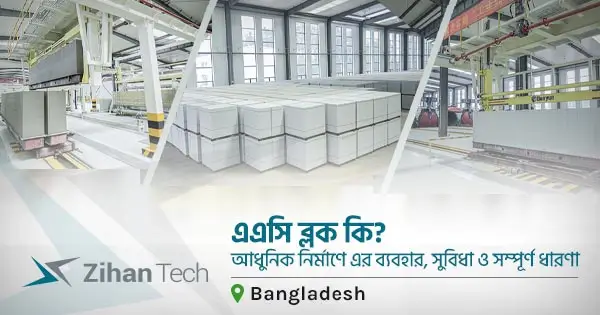
AAC stands for Autoclaved Aerated Concrete. It’s made using a mix of sand, cement, lime, gypsum, aluminum powder, and water. Once the mixture is prepared, it’s placed in a high-pressure steam chamber called an autoclave. This process
creates millions of tiny air pockets inside the block.
The chemical reactions and the perfect procedure make AAC blocks light in weight, strong in structure, and excellent in insulation. In simple terms, it’s a block that feels light to carry but performs like a heavyweight when it comes to wall construction efficiency.
Why is the construction world turning to the AAC block?
There’s no single reason behind AAC’s rising popularity. It’s a mix of factors. Builders are under pressure to finish projects faster. Cities are growing denser. At the same time, the world is trying to cut down on carbon emissions.
AAC fits perfectly into all three needs.
Lightweight & strong: It reduces the overall load on foundations.
Thermal insulation: Keeps the interior cooler by 5-8° C than outside.
Energy efficient: Walls made from AAC keep interiors cooler in summer and warmer in winter, which saves up air conditioning energy.
Significantly lowers construction cost: For its lightweight AAC reduces half of the dead load of the structure, which cuts at least 20% of total construction cost.
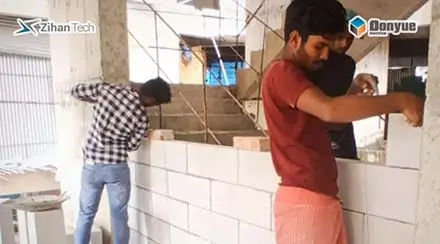
Fast installation: Large block sizes mean less labor time.
Green building compatible: Meets LEED, IGBC, and BNBC sustainability standards.
Cost-saving: AAC Block is costly upfront, but reduces overall project cost.
The AAC scenario in Bangladesh
In Bangladesh, the conversation around eco-friendly materials started picking up around 2020. The reasons were clear. Traditional brick kilns were harming the environment and consuming agricultural soil. So, the government banned new establishment of brick projects. Urban projects
needed alternatives that could meet deadlines without damaging the planet.
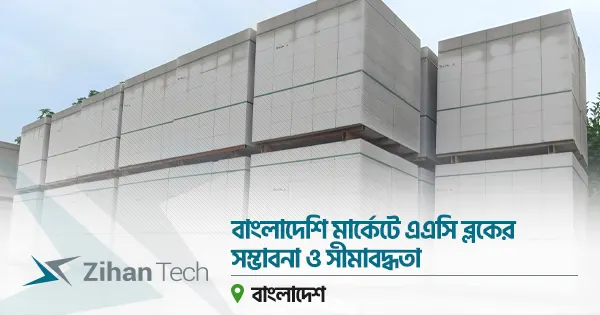
While the current market is still in its early phase, growth is accelerating. Based on internal industry analysis and regional comparisons, Bangladesh’s AAC market is projected
to grow at around 10–12% CAGR between 2024 and 2030.
AAC products are introduced to the market, but the number of factories is still very limited. Zihan Tech is helping new investors set up modern AAC production lines and making the market more self-reliant.
Why AAC is the modern solution for modern construction
Every innovation solves a problem, and AAC solves several. It builds faster, costs less in the long run, and protects the environment. Let’s look at what makes it a perfect match for today’s construction needs:
Speed and efficiency: With larger blocks and better alignment, builders complete projects 30–40% faster.
Lower structural load: Lightweight materials in walls and partition mean significant weight reduction in structure and the foundation.
Energy savings: Keeps indoor temperatures stable, cutting electricity bills for cooling or heating.
Noise control: Excellent sound absorption for schools, hospitals, and apartments.
Eco-friendly: No mining or burning of soil.
Challenges in the local market
Every challenge opens a door for innovation. Awareness programs and joint initiatives between the government and private firms are already addressing these gaps. Machinery suppliers like Zihan Tech are helping bridge these
gaps. AAC still faces a few challenges in Bangladesh:
Lack of awareness among small contractors.
High initial cost for plant setup and machinery.
Very few trusted supplier of AAC machinery.
The future of sustainable construction
If you look at the construction forecasts across Asia-Pacific, one thing stands out clearly: sustainability is no longer optional, it’s the foundation of the next decade of development.
AAC will continue to expand its footprint because it checks every box — speed, cost, energy efficiency, and environmental safety. The Asia-Pacific AAC market is expected to cross USD 11.9 billion by 2030, with South Asia contributing
a significant portion of that growth.
Bangladesh, in particular, has the right momentum. With green construction policies, private sector investments, and rising awareness among developers, the stage is set for AAC to become the backbone of modern architecture.
This change is not just a trend. It’s the future of modern construction.
Wrapping it up
AAC proves that modern construction doesn’t have to harm the environment or drain resources. It’s strong, smart, and sustainable. Bangladesh has the chance to lead this transition in South Asia.
Zihan Tech is helping the industry access modern AAC machinery and reliable technology to build a greener future. We are the only strategic partner for AAC of the renowned Dongyue Group in Bangladesh.
The shift toward AAC isn’t just a technical upgrade. It’s a mindset change. A step toward construction that’s cleaner, faster, and ready for tomorrow. Consult with our expert to set up an
AAC Block production line.
AAC combines strength, lightness, and energy efficiency altogether, and it’s also much more environmentally responsible than clay bricks.
AAC performs exceptionally well in humid and hot weather. Its thermal insulation keeps interiors cool during summer and reduces energy costs. It also resists mold and dampness better than traditional bricks, making it a safer choice for long-term durability.
Yes. While the initial material cost is slightly higher, AAC helps save significantly on foundation size, mortar, and labor costs. It also shortens construction time, which lowers overall project expenses, something large developers appreciate.
The AAC market in Bangladesh is small but growing rapidly. With an annual growth rate projected at around 10–12%, new factories are being planned, and the demand from both residential and commercial sectors continues to rise.
In the long term, yes. As awareness grows and more production plants open, AAC is likely to take over a major share of the walling material market. Governments encouraging green building codes will speed up this transition.
AAC blocks are structurally strong and lightweight, which makes them ideal for multi-story construction. The reduced dead load on foundations improves safety without compromising strength.
Zihan Tech supports the regional growth of AAC by supplying advanced machinery and technology solutions of Dongyue Machinery Group. The company helps investors and manufacturers set up efficient production plants that meet international quality standards.
Build smart with AAC blocks. Learn how AAC blocks reduce construction cost, labor, and structural load compared to brick. Explore AAC solutions from Zihan Tech.