Composition of AAC Block: The components, recipe & formula behind the magic
In the past, buildings mostly used traditional materials like concrete blocks and clay bricks. But as cities grew, temperatures rose, and the need for faster building grew, engineers started to look for smarter ways to do things. That’s
where Autoclaved Aerated Concrete(AAC) came in.
AAC block is a carefully balanced mixture of some materials that makes it lighter, thermal insulating, and more durable than traditional ones. Understanding this composition is essential to appreciating why AAC is becoming the backbone
of modern construction in Bangladesh.
In this blog, we will discuss the components and step-by-step formation process of the AAC Block.
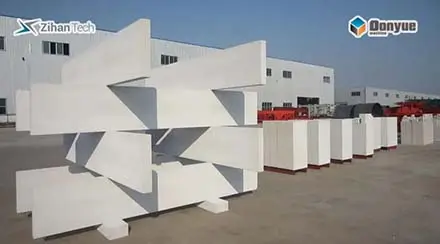
AAC block, also known as Autoclaved Aerated Concrete block. It is a light, precast foam concrete that can be used for both structural and non-structural walls.
The process of making it includes mixing precise amounts of sand(or fly ash), cement, lime, gypsum, aluminum powder, and water.
When this mixture is autoclaved at an exact temperature and pressure, it becomes a porous block that is durable, insulates well, and is easy to work with.
AAC is special because it has a cellular structure with millions of tiny air pockets that are evenly spaced throughout the block. This makes it two to three times lighter than regular bricks.
Elements that form the AAC Block
Each raw material used in AAC manufacturing plays a specific role in the reaction process. The right proportion is crucial for ensuring structural strength, density, and insulation.
Component
Typical Percentage by Weight
Function in AAC Production
Sand
65–70%
Provides the main source of silica, forming calcium silicate hydrates that give strength.
Cement
14–18%
Acts as the binding material that holds the mass together and gives it initial strength.
Lime (CaO)
10–12%
Reacts with silica to form C–S–H crystals during curing, improving long-term strength.
Gypsum
4–5%
Regulates the setting time and prevents excessive expansion.
Aluminum Powder or Paste
500–700gm/cubic meter
Generates hydrogen gas, forming the air voids or pores inside the block.
Water
Balanced
Activates the chemical reactions and provides the slurry texture.
The reaction formula behind AAC formation
The most important part of making AAC is when the aluminum powder, calcium hydroxide (from lime), and water in the slurry react with each other. This reaction makes hydrogen gas (H2), which makes the air bubbles that give AAC its light,
porous structure.
Simplified chemical reaction:
2Al + 3Ca(OH)₂ + 6H₂O → 3CaO·Al₂O₃·6H₂O + 3H₂↑
The mixture expands to almost double its volume within two hours. Once the reaction stabilizes, the material is partially solidified and ready for cutting and curing.
Step-by-step formation process of AAC Blocks
Each stage required proper factory maintenance to ensure the best quality and performance. Explore the step-by-step formation process of AAC Blocks
Mixing: Cement and lime are mixed with the sand-gypsum slurry at the accurate proportion.
Addition of Aluminum Powder: The aluminum reacts instantly, creating hydrogen gas bubbles that expand the mixture.
Pre-Curing: The mix rises and sets enough to hold its shape (like a soft cake) in 2-3 hours.
Cutting: The solidified “cake” is cut into precise block sizes using wire-cutting machines.
Autoclaving: The blocks are steam-cured in autoclaves at about 180–204°C and 12-16 bar pressure for 9-10 hours.
Finished product: The hydrogen gas escapes, leaving microscopic air pockets that define the final lightweight structure.
Role of Autoclaving: The key to strength and durability
Autoclaving is where the recipe really transforms. As the combination is subjected to heat and pressure, both calcium and silica interact to create tobermorite crystals (C₅S₆H₅). It’s these crystals that make AAC so incredibly
strong.
In the line chart of strength vs. curing time of Autoclaving, you would see a quick rise in strength in the first 5 hours, followed by a steady increase until 10 hours. The strength curve levels off after that point, which means the
block is fully formed.
The X-axis represents curing time (hours).
The Y-axis represents compressive strength (MPa).
Autoclaving usually takes 9-10 hours to complete the full process. In the curve, you will see that the process starts low, climbs steeply between 3 and 5 hours, rises gradually until, and then levels off,
showing that further autoclaving doesn’t add much strength. By this process, the autoclave turns the raw mix into a solid, reliable building material.
Comparison: AAC Block vs. Traditional Clay Brick
AAC Block is a smart construction technology that is used in modular and prefabricated buildings worldwide. AAC Blocks are used instead of clay bricks in many countries to build in an environmentally friendly way.
Quality control in material testing is essential to maintaining batch consistency. Each test shows how consistent the block's chemical and physical makeup is. The Bangladesh National Building Code(BNBC) provides guidelines aligned with global standards.
To ensure that every AAC block meets both national and international standards, manufacturers conduct several tests:
Bulk density test: Measures the lightness and confirms correct pore formation.
Compressive strength test: Ensures structural safety and durability.
Water absorption test: Determines moisture resistance.
Dimensional accuracy check: Ensures smooth installation at construction sites.
Advantages derived from AAC composition
The balanced chemistry of AAC's composition gives it a lot of performance benefits:
Thermal insulation: Air cells reduce heat transfer, resulting in a temperature difference of 4-7°C between the interior and exterior. which cuts down on cooling energy by 25–30%.
Lightweight structure: This is great for multi-story buildings because it reduces the dead load to 50%.
Eco-friendly manufacturing: No agricultural soil is mined or burned.
Cost efficiency: Less need for mortar, plaster, and support for the structure.
Sound absorption: The porous matrix minimizes external noise.
The composition of an AAC block is what gives it its “magic.” The synergy between sand, cement, lime, water, and aluminum powder results in a lightweight, durable, and thermally efficient product, perfect
for the evolving construction standards of Bangladesh.
Zihan Tech not only provides the machinery, but also offers a solution from planning to production and full-time client support for factory arrangements. The science behind AAC is complex, but the result is simple: durable and greener construction for the future.
AAC blocks are made of sand or fly ash (the silica source), cement, lime, gypsum, aluminum powder, and water. When these ingredients are put under steam pressure, they react to make a solid, light structure with tiny air pockets inside.
Aluminum reacts with lime and water to release hydrogen gas, forming the pores that give AAC its lightweight nature. Without this reaction, the block would remain dense like regular concrete and lose its insulation benefits.
When aluminum comes into contact with lime and water, it releases hydrogen gas. This gas creates the tiny holes that make AAC so light. To facilitate the reaction, the exact temperature and pressure are assured in the autoclave.
To make red bricks, clay is burned at high temperatures. To make AAC, lime, silica, and aluminum react with each other. The end product is a crystalline, non-fired material that is lighter, uses much less energy, and is eco-friendly.
Too much or too little lime or aluminum can cause the material to expand too much or not enough, which can lead to cracks or uneven strength. Consistency is guaranteed by keeping the right formula and using automatic batching.
The uniform distribution of air voids that happens during the chemical reaction keeps heat from moving around, which keeps indoor spaces cooler in the summer and warmer in the winter.
Zihan Tech provides advanced AAC machinery and technical consultancy for factory setups of AAC in Bangladesh.